RAG Failure Cases: When Retrieval Goes Wrong
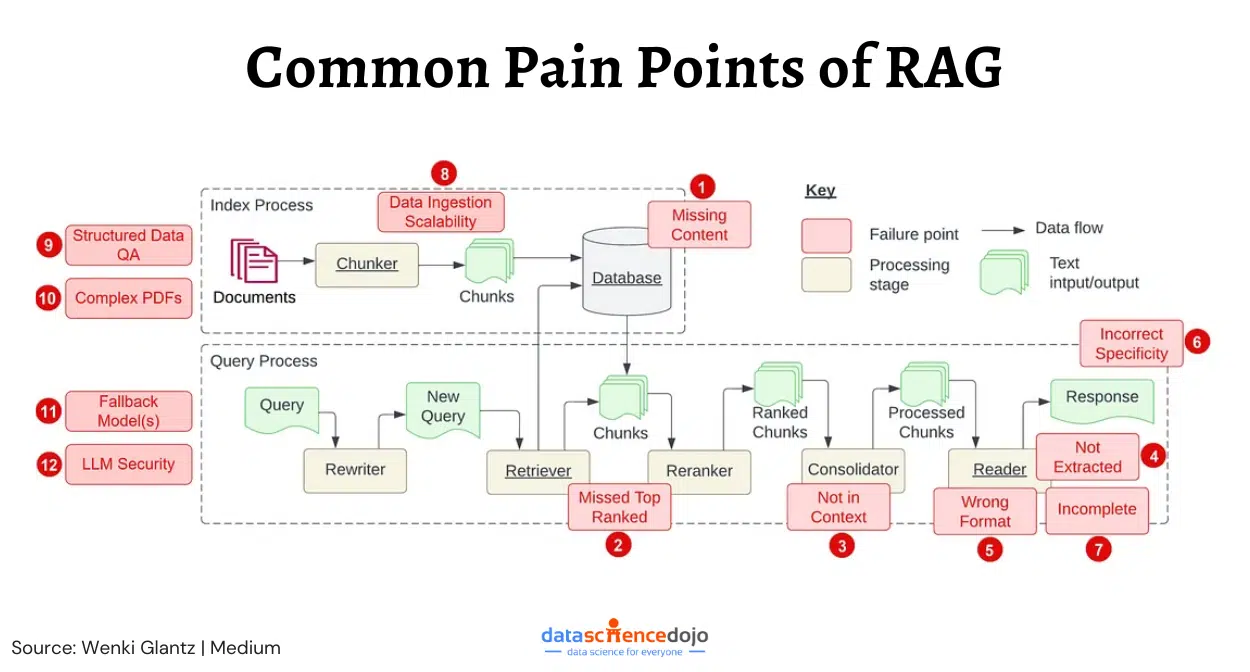
Building a RAG (Retrieval Augmented Generation) system seems straightforward in theory: retrieve relevant documents, feed them to a language model, and get accurate responses. But anyone who's deployed RAG in production knows the reality is messier. RAG systems can fail in subtle and not-so-subtle ways, leading to frustrated users and unreliable AI applications.
In this deep-dive article, we'll explore the most common RAG failure patterns that plague real-world systems, understand why they happen, and most importantly, learn practical strategies to prevent and fix them. Whether you're debugging an existing RAG system or planning a new implementation, this guide will help you build more robust and reliable retrieval-augmented applications.
The Reality Check: Why RAG Systems Fail
Before diving into specific failure cases, it's important to understand that RAG is a complex pipeline with multiple points of potential failure. Unlike a simple API call, RAG involves:
Document preprocessing and chunking
Vector embedding and indexing
Query processing and retrieval
Context assembly and generation
Post-processing and response formatting
Each step can introduce errors that compound downstream. Let's examine the most critical failure modes and their solutions.
1. Poor Recall: When Relevant Information Goes Missing
The Problem
Poor recall occurs when the RAG system fails to retrieve relevant documents that exist in the knowledge base. Users ask questions that should have clear answers, but the system either returns irrelevant results or claims it doesn't know the answer.
Root Causes
1. Vocabulary Mismatch
The query uses terms like "paternity leave" while the document uses "parental leave benefits" – semantically similar but lexically different.
2. Inadequate Embedding Models
The embedding model doesn't capture the semantic relationship between query and document terminology.
3. Poor Query Preprocessing
The system doesn't expand or reformulate queries to match document vocabulary.
4. Insufficient Retrieval Depth
The system only looks at the top 3 results when the relevant document is ranked 7th.
2. Bad Chunking: Breaking Context at the Wrong Places
The Problem
Bad chunking occurs when documents are split in ways that fragment important information across multiple chunks, or when chunks contain irrelevant information that dilutes the context.
Root Causes
1. Fixed-Size Chunking Blindness
Splitting text every N characters without considering semantic boundaries.
2. Ignoring Document Structure
Not respecting headings, lists, paragraphs, and other structural elements.
3. No Context Preservation
Failing to maintain relationships between related pieces of information.
4. Inappropriate Chunk Size
Chunks too small lose context; chunks too large dilute relevance.
3. Outdated Indexes: When Knowledge Becomes Stale
The Problem
Outdated indexes occur when the RAG system's knowledge base contains obsolete information, but the retrieval mechanism continues to surface old data as if it were current.
Root Causes
1. Infrequent Index Updates
Knowledge base updated manually or on irregular schedules.
2. No Version Control
Multiple versions of documents exist without proper versioning.
3. Lack of Freshness Signals
No mechanism to identify or prioritize recent information.
4. Poor Document Lifecycle Management
No systematic approach to deprecating old information.
Conclusion:
RAG systems are powerful but complex, and failure is often not a matter of "if" but "when" and "how gracefully you handle it."
Key Takeaways
Poor Recall: Use hybrid search, query expansion, and increase retrieval breadth
Bad Chunking: Implement semantic chunking with overlapping windows and context preservation
Query Drift: Classify query intent and use multi-stage retrieval with query reformulation
Outdated Indexes: Set up automated updates with version control and freshness scoring
Weak Context Hallucinations: Check context sufficiency and generate conservative responses when uncertain
By implementing these mitigation strategies and maintaining a focus on continuous improvement, you can build RAG systems that users trust and rely on. The goal isn't perfection – it's building systems that are robust, transparent about their limitations, and continuously improving.


