Vector Embeddings
When humans read a sentence, we instantly understand the meaning, context, and relationships between words. Computers, however, don’t “understand” language in the same way. They work with numbers, not words. This is where vector embeddings come in a way to represent text as numbers so that machines can process and compare meanings.
What Are Vector Embeddings?
A vector embedding is a way of representing data such as text, images, or audio as a list of numbers (a vector). These numbers capture important features about the data so that similar things are represented by similar vectors.
For text, this means words, sentences, or entire documents can be converted into numerical vectors in a way that preserves their meaning. The “closeness” of these vectors in space reflects how semantically related the original items are.
Example:
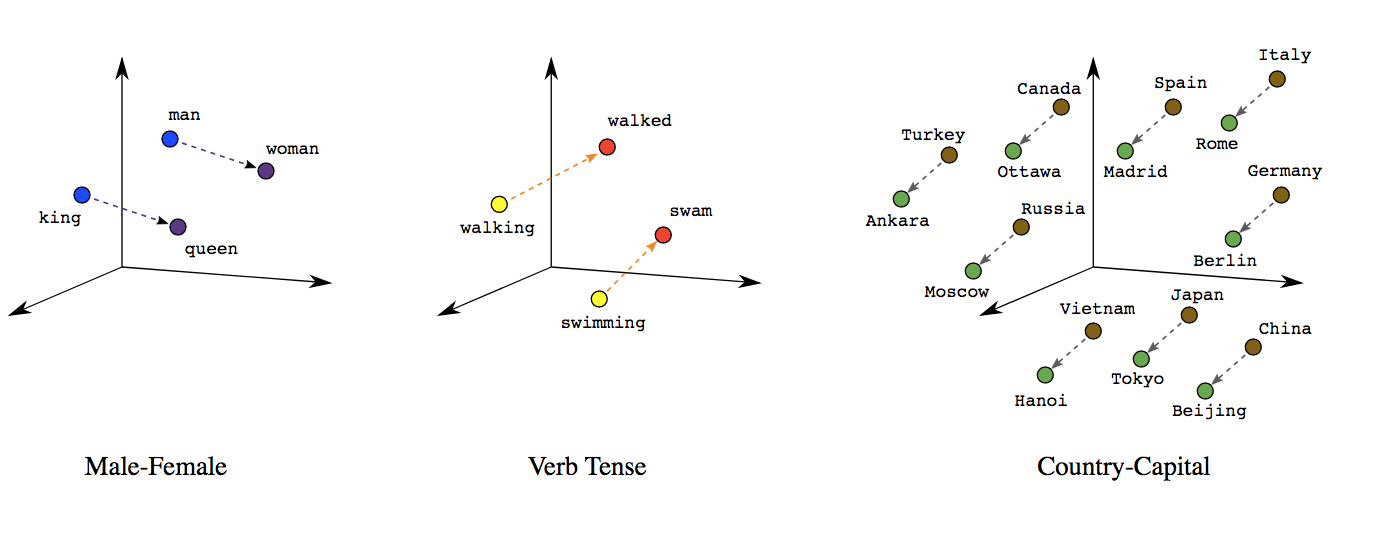
The vectors for "Paris" and "France" are close in meaning (capital–country relationship).
You can capture this relationship mathematically:
Vector("Paris") - Vector("France") + Vector("Japan") ≈ Vector("Tokyo")
This shows that embeddings can learn analogies — in this case, “capital of a country.”
Why Do We Need Embeddings?
Computers can’t naturally understand the meaning of raw words. If we assigned simple IDs (like cat = 1, dog = 2), the machine wouldn’t know that “cat” and “dog” are more related than “cat” and “banana.”
Embeddings solve this problem by:
Placing similar meanings closer together in a vector space.
Allowing models to discover patterns and relationships in data.
Enabling tasks like semantic search, clustering, translation, and sentiment analysis to work effectively.
How Are Embeddings Created?
Embeddings are dense numerical vectors that capture meaning in a way machines can understand. They’re learned by training models on large datasets, where the goal is to place similar meanings close together in a high-dimensional space.
1. Data Preparation
The text (or other data) is cleaned and tokenized — split into smaller pieces such as words, subwords, or characters. Each token is given an initial numeric representation, often random at first.
2. Training with Neural Networks
A neural network learns the vector values during training.
Classic word embeddings like Word2Vec, GloVe, and FastText are trained on massive text corpora.
The model picks up statistical patterns — for example, if “king” appears near “queen” and “man” appears near “woman,” it adjusts the vectors so that the relationships match in the vector space.
Example:
Vector("king") - Vector("man") + Vector("woman") ≈ Vector("queen")
3. Contextual Embeddings
Modern models like GPT produce contextual embeddings, meaning the same word can have different vectors depending on its sentence.
- “bank” in river bank will have a different vector than “bank” in money bank because the surrounding words change the meaning.
4. Dimensionality and Representation
An embedding is simply a list of numbers — often 300, 512, or 1536 dimensions long.
A “dimension” isn’t a human-readable trait like “color” or “size.”
Instead, each is a learned feature, and together they form a rich representation of meaning.
These vectors live in a vector space, where closeness = similarity.
5. Fine-Tuning for Specific Tasks
Once a general embedding model is trained, it can be fine-tuned for tasks like sentiment analysis, recommendation systems, or semantic search.
- Fine-tuning slightly adjusts the vectors so they’re optimized for the new purpose while keeping the core semantic structure intact.
Conclusion
Vector embeddings are the bridge between human language and computer understanding. They capture the meaning of words, sentences, and even larger text pieces in a mathematical form that allows algorithms to find patterns, similarities, and relationships. For beginners in natural language processing, understanding embeddings is a key step toward building smarter and more context-aware applications.